
Wednesdays: 7:00 to 10:00 p.m.
Location: Our sessions will be held virtually
and synchronously
David McKie, Phone: (C) 613-290-7380

Jim Bronskill, Phone: (C) 613-859-3752
David, Fred Vallance-Jones, Rob Cribb and Dean Jobb are co-authors of
Digging Deeper Third Edition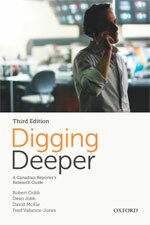
David McKie and Jim Bronskill are co-authors of
Your Right To Know: How to Use the Law to
Get Government Secrets

David and Fred are co-authors of
“The Data Journalist: Getting the Story“
Assignments and Evaluation | Course Schedule |Data Visualization |Backstory |Dollars and Sense story |Access-to-information assignment | Week one | Week two | Week three | Week four | Week five | Week six | Week seven | Week eight | Week nine | Week ten | Week eleven | Week twelve | |Tutorials | Datasets |
Course Objectives
1) Obtain a thorough grounding in journalistic research methods.
2) Acquire skills needed to make sense of the information gathered.
3) Develop the ability to shape the information into accurate and compelling stories for all platforms.
Requests for Academic Accommodation
You may need special arrangements to meet your academic obligations during the term. For an accommodation request, the processes are as follows:
Pregnancy obligation
Please contact your instructor with any requests for academic accommodation during the first two weeks of class, or as soon as possible after the need for accommodation is known to exist. For more details https://carleton.ca/equity/accommodation/pregnancy-accommodation-form/
Religious obligation
Please contact your instructor with any requests for academic accommodation during the first two weeks of class, or as soon as possible after the need for accommodation is known to exist. For more details https://carleton.ca/equity/accommodation/religious-observances/
Academic Accommodations for Students with Disabilities
If you have a documented disability requiring academic accommodations in this course, please contact the Paul Menton Centre for Students with Disabilities at 613-520-6608 or for a formal evaluation or contact your PMC coordinator to send your instructor your Letter of Accommodation at the beginning of the term. You must also contact the centre no later than two weeks before the first in-class scheduled test or exam requiring accommodation (if applicable). After requesting accommodation from the centre, meet with your instructor as soon as possible to ensure accommodation arrangements are made. For more: https://carleton.ca/pmc/
Survivors of Sexual Violence
As a community, Carleton University is committed to maintaining a positive learning, working and living environment where sexual violence will not be tolerated, and its survivors are supported through academic accommodations as per Carleton’s Sexual Violence Policy. For more information about the services available at the university and to obtain information about sexual violence and/or support: https://carleton.ca/sexual-violence-support/
Accommodation for Student Activities
Carleton University recognizes the substantial benefits, both to the individual student and for the university, that result from a student participating in activities beyond the classroom experience. Reasonable accommodation must be provided to students who compete or perform at the national or international level. Please contact your instructor with any requests for academic accommodation during the first two weeks of class, or as soon as possible after the need for accommodation is known to exist. https://carleton.ca/senate/wp-content/uploads/Accommodation-for-Student-Activities-1.pdf
For more information on academic accommodation, please contact the departmental administrator or visit https://students.carleton.ca/course-outline/
Respectful Discussion
Discussion and debate play valuable roles in online and in-person classes. Differing views should focus on the content of the material and efforts should be made to understand how a person’s lived experience might or ought to shape their perspectives. Racist, sexist, homophobic, transphobic, and ableist language will not be tolerated.
Diversity
Carleton’s journalism program is committed to creating a welcoming, stimulating, professional and creative environment for our increasingly diverse student body. We commit to eliminating racism against Racialized and Indigenous people as well as inequities or other barriers based on ethnicity, nationality, religion, gender expression, sexual orientation or ability. We hope our program’s commitment to anti-racism and anti-oppression practices will benefit all of our students while they are here and that it will foster a wider culture of equity and inclusion in newsrooms of the future as they respond to and report on an increasingly diverse society.
The Permanent Working Group was established in order to help keep the journalism school on track with structural changes that aim to make the school a safe and welcoming environment for all students. The group also provides specific direction and advice to the journalism program committee and head on matters pertaining to equity and inclusion. Students wishing to propose programmatic ideas or who have concerns may contact us directly via https://carleton.ca/sjc/journalism/equity-and-inclusion/permanent-working-group/
The Department of Equity and Inclusive Communities fosters the development of an inclusive and transformational university culture where individual distinctiveness and a sense of belonging for every member drive excellence in research, teaching, learning and working at Carleton. Students with complaints may direct them to the Department of Equity and Inclusive Communities via https://carleton.ca/equity/
The journalism program has a student-led Association for Equity and Inclusion in Journalism. Its mission is to make the journalism school a safe(r) space for Black, Indigenous, and students of colour, 2SLGBTQ+ students and students with disabilities/disabled students. More information about the association can be found at https://carleton.ca/sjc/journalism/equity-and-inclusion/student-association/
Instructions for setting up your campus pin card
Details can be found here: https://carleton.ca/technicalservices/card-access-how-tos/
Textbooks
Digging Deeper 3rd edition is the main textbook for this course. It is available at the Carleton bookstore. Buying the book online is another option. The Data Journalist is an optional textbook, which will come in handy during the weeks when we focus on data. And Your Right To Know, also an optional textbook, will be useful for our access-to-information sessions.
Assignments and Evaluation(TOP)
Assignments in this course are governed by the provisions of the document Ethics and Standards in the School of Journalism and Communication. There are four assignments, each with a deadline. Lateness will be penalized, though exceptional circumstances will be taken into account. There is no final examination. With the exception of the access-to-information assignment, each has three components, all of which will figure in the grade:
- Copies of the actual documents compiled / gathered.
- A description of how the documents were obtained and why they were useful.
- The resulting story or visualization.
Each of the four assignments is worth 20 per cent of the overall course grade. The remaining 20 per cent of the grade will be determined based on presence / punctuality, participation and professionalism, including quiz results.
Due Dates
1) Data visualization outline due Mon., Feb 8, noon.
2) Data visualization due Sun., Feb. 14, noon.
3) Backstory outline due Tues., Feb. 23, noon.
4) Access-to-information requests must be filed by Mon., Feb. 22.
5) Backstory assignment due Sun., March 7, noon.
6) Dollars and Sense outline due Fri., March 12, midnight.
7) Dollars and Sense story due Sun., March 21, noon.
8) Access-to-information assignment due Sun., March 28, noon.
Grades (additional information)
The passing grade for this course is B minus.
Informal questions or appeals about your grade on assignments or other graded components of the course should be raised with the instructor no later than seven business days after the grade has been issued.
For information about the formal Grade Review process, please see the Graduate Regulations: http://calendar.carleton.ca/grad/gradregulations/administrationoftheregulations/#15
Standing in a course is determined by the course instructor subject to the approval of the Faculty Dean. This means that grades submitted by an instructor may be subject to revision. No grades are final until they have been approved by the Dean.
Academic Integrity
This course abides by Carleton University’s Academic Integrity Policy. Acts of academic dishonesty include, but are not restricted to, plagiarism and unauthorized resubmission of work, and will be dealt with accordingly. Plagiarism is a serious offence, which cannot be resolved directly between the student and the course instructor. Penalties are not trivial. They can include a final grade of “F” for the course.
- Do not, under any circumstances, present someone else’s work as your own.
- Do not download and/or copy any files, stories, photos, audio or video you find online or elsewhere and use them as your own.
- Do not fabricate sources of information.
- Do not invent facts.
General Regulations, Section 19, of the Graduate Calendar http://calendar.carleton.ca/grad/gradregulations/. If an academic offence is suspected, it will be referred to the Office of the Dean of the Faculty of Graduate and Postdoctoral Affairs.
Ethics and Professional Standards
This is a professional school, and you’ll be held to professional standards in both assignments and conduct. As a student of journalism, you must read and adhere to the School’s policies.
- Our ethics policy sets out the rules of behaviour that you, as students and journalists, are expected to follow as you carry out your assignments for this course. One of the rules, for example, makes clear that you must not interview relatives or friends for your story, except in rare and special circumstances and with the advance permission of the instructor.
- Our publishing policy requires certain authorizations before journalistic coursework can be published outside of the class. In addition, your sources must understand that any assignments they are associated with may be published outside of class.
- Our policy on electronic media usage requires that you follow copyright regulations with respect to your use of all materials culled from the Internet. For example, you cannot use any pictures you find online in your assignments unless you get written permission from the copyright holder to use them and submit it to the instructor.
Graduates can find all three policies here https://carleton.ca/sjc/journalism/graduate-studies/resources-current-students/
You are expected to be familiar with these policies and apply them to your work. Failure to abide by them will adversely affect your standing in the course.
If you have questions about the journalism program, degree requirements, your standing in the program or your academic audit, you should contact your Graduate Administrator Jena Lynde-Smith at or Graduate Supervisor Janice Tibbetts at
Course Schedule (TOP)
Jan. 13: a. Course introduction / self-assessment b. Introduction to Access to information c. Access-to-information tips: Previously released records
|| Reading: Digging Deeper, Chapters, 1, 2, 10
Jan. 20: a. Access-to-information tips: Previously released records, focusing a request, negotiating, seeking partial releases b. Assignment: Access to information
|| Reading review: Digging Deeper, Chapters, 1, 2, 10
Jan. 27: a. Data (part one) b. Assignment: Data visualization
|| Reading: Digging Deeper: Chapter 11
|| Optional reading: The Data Journalist: Chapters 2, 4
Feb. 3: a. Data (part two)
|| Reading: Digging Deeper, Chapters 3,4, 6
|| Optional reading: The Data Journalist: Chapter 8
Feb. 10: a. Introduction to historical records b. Assignment: Backstory c. Data visualization due Sun., Feb. 14, noon.
|| Reading review of chapters covered so far to prepare for Feb. 24 quiz
Feb. 17: Break Week. No class scheduled.
Feb. 24: a. Data visualization feedback. b. Quiz based on readings and in-class learning
c. Elements of storytelling d. Access-to-information requests must be filed by Mon., Feb. 22
|| Reading: Digging Deeper, Chapters 7, 8
March 3: a. Dollars and Sense (part one) b. Assignment: Dollars and Sense story
c. Backstory assignment due Sun., March 7, noon.
|| Reading: Digging Deeper, Chapter 9
March 10: a. Dollars and Sense (part two) b. Public records (part one)
|| Reading review: Chapters 4, 9
March 17: a. Backstory feedback b. Public records (part two) c. Dollars and Sense story due Sun., March 21, noon.
|| Reading: Chapter 7
March 24: a. Access-to-information tips: Making sense of records (decoding documents, chronologies) b. Access-to-information assignment due Sun., March 28, noon
|| Reading: Chapter 5
March 31: a. Dollars and Sense story feedback b. Data: Additional techniques
|| Reading review: Digging Deeper, Chapters 4, 5, 7, 8, 9
April 7: a. Access-to-information assignment feedback b. Quiz based on readings and in-class learning c. Enterprise journalism tactics
Virtual office hours
We are available to discuss course material and assignments with you by email, phone or after class. Our virtual office hours are Wednesday 11 a.m. to noon – please advise David or Jim in advance that you would like to speak with one or both of us.
Data visualization (TOP)
A digital visualization that tells a story based on analysis of data, due Sun., Feb. 14, noon. (An outline is due Mon., Feb 8, noon.)
What is required for emailed outline draft visualizations?
- The dataset(s) you want to use in an Excel workbook that contains three tabs: the original dataset with the URL pasted into the first available cell in the first row; two subsequent worksheets with the filtered datasets that will be visualized. The Excel workbook
- A brief, point-form explanation in the body of an email of why the data tables are newsworthy.
- At least two public records to support the visualization uploaded to DocumentCloud and annotated.
What is required for the approved visualizations?
- Two newsworthy visualizations displaying two different trends from your dataset. For instance, one could be the kind of vertical bar chart. The second, a map.
- The visualizations must be newsworthy. For instance, a Statistics Canada table that has recently been published and mined for new information that adds value to what we already know. In the case of unemployment statistics, we will have compared the unemployment numbers for young men and women between the ages of 15 and 24 — before and after the pandemic. Ideally, these numbers should be used in stand-alone, value-added visualizations that can be shared on social media as a way of bringing eyeballs to an original story.
- You must use up to 100 words to set up each visualization, using AT LEAST three of the kinds of public records described in chapter 4 of Digging Deeper for contextual background information.
- The public records MUST be uploaded to DocumentCloud with the appropriate annotations.
- Upload the visualizations and explanations to the “ReportingMethods2021_1” category.
What’s to be submitted?
- Two DIFFERENT visualizations in ONE blog post kept in draft format. Each visualization must be accompanied by a 100-word explanation that explains the news value. Upload the blog post to the category “ReportingMethods2021_1”
- A 500-word explanation in a Word document that briefly explains why you chose the visualizations, their news value, and the public records you used to provide context.
- In your explanations used to set up the visualizations, there must be links to be AT LEAST three different public records uploaded to DocumentCloud (Don’t worry! You will learn how to upload and annotate documents.). The DocumentCloud links MUST take readers to the appropriate annotations in the public record. You can use a SAME record for each visualization.
- The Excel workbook that contains four worksheets: worksheet one – the original table with the URL pasted into the first available cell in the first row; worksheet two – the working copy of the original table; worksheet three – the filtered and cleaned-up table used to provide the first visualization; worksheet four – the cleaned-up table used to provide the second visualization. Only provide ONE workbook, even if you are using two tables from different datasets. The visualization does not have emerge from a pivot table. It can also be from regular table that is filtered and sorted.
Data visualization frequently asked questions
Q: Can I choose any dataset?
A: You have a fair degree of flexibility. Be sure to link the visualizations to an event making news.
- Can I choose a dataset we have used as an example in class?
A: Yes, but you would have to come up with different examples than the ones we used in class. For instance, you can use Statistics Canada’s Labour Force data that tracks employment. However, you MUST use different numbers. - Can the graph visualization be a jpg or png file?
A: No, it must be embedded, allowing for a level of reader engagement?
Q: Does the topic have to be national, provincial, or municipal?
A: Either one will do, but the safest choice would be one of the sources we have discussed in class.
Q: So, where do I get my datasets?
A: From a federal (Statistics Canada), provincial or municipal open-data portals. The links are posted on the syllabus.
Q: How current must my data be?
A: As current as possible, meaning that there should not be a lag time of more than two years, otherwise the data may be too old.
Q: Given that we are still in the middle of a pandemic, does the data have to be related to COVID-19?
A: No, but the pandemic would be difficult to avoid.
Q: Do I need to ask for more detailed data?
A: You can, but if the dataset has enough detail, then you should be fine.
Q: Can I use two similar visualizations?
A: For the sake of variety, you MUST create two COMPLETELY DIFFERENT ones. For instance, a dataset that contains important numbers may also have geographic information such as longitude and latitude coordinates, or names of countries, provinces and cities. In this case, you could display your numbers from your Excel spreadsheet in an infographic. In a second visualization, you could then display the geographic coordinates in Tableau which, in addition to our in-class reviews can also be found in this Digging Deeper online tutorial.
Q: Will I lose marks for neglecting to ensure my visualizations have titles, cutlines, and credits for sources?
A: Yes. Half a grade
Q: Will I lose marks for neglecting to upload and annotate my public documents in DocumentCloud? Yes, half a grade.
A: Yes.
Q: Will I lose marks for embedding a graph as a jpg or png file?
A: Yes, half a grade.
Q: How should I use the public records?
A: As background information to provide context or advance the story.
Q: Can a public record be an article or news report?
A: No. The focus in this course is the use of the primary records described in Digging Deeper. While news reports that show up in your Google alerts are useful as tipsheets for sources of information, they can not be the primary reference, in large part because the reports could contain inaccuracies.
Q: Do I have to interview anyone?
A: No. The point of this assignment is to see how adept you are at choosing information from a publicly available dataset to display, and then consulting public records to add context.
Q: Do I have to run the dataset by you?
A: Yes. The point of submitting a draft is to ensure that the pitch has all the information you need to create a successful, newsworthy visualization.
Backstory assignment (TOP)
A story that draws on archival- or library-based sources from at least 40 years ago (1981 or earlier) to provide historical depth on a current Canadian issue or event. 600 words, due Sun., March 7, noon. (An outline is due Tues., Feb. 23, noon.)
Outline checklist:
Send your outline (pasted in the body of an email, not a Word document) by Tues., Feb. 23, noon.
It should be no more than 200 words and include:
A few words about the original issue or event from 40 or more years ago.
Why is it timely to revisit this issue or event now? (i.e. what is happening today that makes it worth looking into the backstory?)
What kinds of historical sources do you hope to use in your research (e.g. newspaper archives, parliamentary debates, archival documents, a memoir, photographs)?
Story Checklist
The story must include:
- Evidence of first-hand research involving historical records, photographs, news articles, museum artifacts or similar materials.
- Comments from someone involved in the original issue or events and-or an expert who is familiar with them and can provide context.
- At least one photo or other illustration to accompany the story.
- Copies of two pieces of documentation gathered during research for your story (not more than one or two pages apiece).
- For EACH of the two pieces of documentation, full-sentence answers to these questions:
(*) What is the documentation?
(*) How did you find/obtain it?
(*) Why was the documentation helpful?
Backstory: Frequently Asked Questions
Q: How do I hand in my assignment?
A: Upload everything – including documents and answers to the three questions – to the relevant “category” of the syllabus (ReportingMethods2021_2). Save it as a draft. It doesn’t matter what format you choose, but most supporting material should be in PDF, .jpeg or Word format. You can also use DocumentCloud to upload pages of your records to the syllabus.
Q: Can I write about non-Canadian events?
A: No.
Q: Does my topic have to be a national issue?
A: No, it could be a provincial or local one.
Q: Can I just revisit any interesting episode from the past?
A: No, there has to be a reason you’re writing about this subject – a clear and substantial connection to something happening today. For instance, given the COVID-19 pandemic, you might look at the flu outbreak of 1918. (DON’T DO THIS ACTUAL TOPIC.)
Q: I am writing about events that took place 100 years ago and everyone involved is dead. Will that work?
A: Yes, that’s fine, and it’s why I have made it optional to interview someone involved in the original events. But perhaps you will find a diary entry or autobiography quotation that will help bring a deceased person’s voice into the story. And if your story involves events from 50 or even 60 years ago, I would hope you could track someone down from the era to interview.
Q: What sort of documentation do you want?
A: It could be almost anything that helped you do the story: a photo of a relevant page from a memoir, a page from an archive, a Canada 411 entry that helped you find someone to interview, an excerpt from an interview transcript – the choice is yours.
Q: Could my illustration(s) accompanying the piece double as my documentation?
A: Quite possibly, if they helped you do the story. Be sure you have permission to post the photos or other illustrations from the rights holder or creator.
Dollars and Sense story (TOP)
A news story based on the financial records of a public institution. 600 words, due Sunday, March 21, noon. (An outline is due Fri., March 12, midnight)
What is required?
1) A news story about any aspect of a publicly traded company that has been affected by COVID-19.
2) The story MUST come from the financial statement: a calculation you’ve made using numbers; any aspect of the discussion that relates to the impact COVID-19 is having on the bottom line.
3) Upload the story to the first of the four categories on the website, ReportingMethods2021_3.
4) AT LEAST two interviews: One with an expert; the second with an individual with a direct connection to the specific program or program area at the heart of the story. For instance, the latter could be a person, group or institution impacted by the company’s financial difficulties or success. The former could be an economist or a university or college professor who studies the corporation.
What do you need for the initial draft on March 12?
A lede, followed by a point-form explanation that contains the following: where you see the story heading; the financial record(s) and a possible Statistics Canada table(s) for additional context; possible interviewees.
The information described above MUST be contained in an email.
What’s to be submitted on March 21?
1) An emailed, 500-word explanation in a Word document that briefly explains — in point form, even — the steps you took to get the story, the coordinates of your interviewees and the people you attempted to interview.
2) An Excel sheet with your calculations emailed as an attachment. Please ensure that all the tables (possibly from different datasets) are in ONE Excel workbook.
3) In addition to uploading the story to the “ ReportingMethods2021_3” category on our website, a Word document with your actual story, which will contain my feedback.
4) The uploaded story to the website MUST have at least two visualizations similar to the ones required for the data-visualization assignment: a simple graph in a program such as Tableau that displays the key numbers; a large photograph — column-width; an infographic; if possible, an embedded line graph showing the company’s stock prices going back to at least six months before the pandemic. You MUST also upload your financial statement(s) and other possible documents to DocumentCloud and annotate the appropriate sections.
Dollars and Sense Story Questions and Answers
Q. What company record do I need?
A. A publicly traded company’s most recent financial statement.
Q. Do I need any other documentation?
A. Possibly other financial statements from the company to help round out the narrative. For instance, Canada’s Big Six banks have done very well, according to their most recent filings. You could use a quarterly report to illustrate a part of their success, or challenge that has yet to be reported, or has received little attention. Then, if you wanted to round out the story to include executive salaries, you’d need a recently-released proxy statement – described on page 214 of Digging Deeper – to obtain the figures for the CEO and other top bosses.
Q. How can I tell a story about a company whose financial situation has already made news?
A. Report on a new number or a section of the financial statement such as the management discussion and analysis that has not made news. Or a section that provides fresh detail about the havoc the pandemic has wrought.
Q. Can you give me an example?
A. One of the vaccine makers talked about the uncertainty that surrounded their initial research and subsequent clinical trials, and admitted that they were bracing for possible failure and a loss of their investment.
Q. So, this story can be a lookback?
A. Yes. By their very nature, recently-released financial statements are snapshots in time. What you’re looking for is fresh information the provides context on an aspect of the company’s business during the period in question.
Q. Can the story also look ahead?
A. Yes. Again, using the same criteria. Fresh information. Typically, financial statements will discuss future challenges.
Q. Can you provide an example?
A. A company may issue a specific warning about what could happen if it doesn’t receive more government support, or if the economy continues to tank.
Q. Can I use Statistics Canada information about economic information such as job numbers for additional context?
A. Absolutely! If you are discussing a company’s fourth quarter, which could be the last three months of 2020, you’d want to use tables that measure unemployment or the impact on industrial sectors for that time period to provide additional context. In short, feel free to build on the work you did for the data-visualization assignment.
Q. What should be in the draft that I submit?
A. I only need a tightly written lead, based on the principles we’ve discussed in class, followed by a point-form description of possible interviewees (and please be realistic), where you see the story heading and the key numbers you’ll be using, which should be no more than two or three.
Q. How can I write a lead if I haven’t completed my research?
A. Write a lead based on the information at hand. Admittedly, the story may change based on further discoveries. However, the exercise of writing early drafts helps sharpens the mind, and keeps you focused. For instance, you can write a lead based on a calculation from the company’s balance sheet, or an interesting insight from the management discussion and analysis section.
Q. So, can I still submit a draft if I haven’t done any interviews?
A. Absolutely! You can craft a lead, and then spell out who you’d like to interview. This step alone will allow for some healthy brainstorming well ahead of your deadline, which should make it easier to find the right voices.
Q. Must the story emerge from the numbers in the financial statement?
A. Yes!
Q. What documentation should I use?
A. The company’s most recent quarterly or annual report. A fourth quarter filing doubles as an annual report, covering four quarters of the company’s fiscal year.
Q. Must I provide hyperlinks to the annotation in my story?
A. Yes. This is a MUST. This allows readers to quickly locate and digest the source of your information from the type of primary records discussed in Digging Deeper.
Q. Will I be deducted marks for neglecting to upload and annotate my documents?
A. Yes.
Q. What if I have trouble contacting people?
A. To be on the safe side, avoid relying on a limited number of sources. The wider you cast your net, the better. And avoid waiting until the last minute by exercising good time management. Start with the obvious: people affected by the company in question, customers, clients, etc.
Q. Must I interview a company representative?
A. Try. Failing an interview, a written statement will do. Failing that, just point out in the story that the company neglected to respond to requests for an interview or comment. And then try to find what the company has said publicly in a news release, in a recorded interview that allows you so see or hear what was said, rather than relying on a quote that might be inaccurate.
Q. Can I use what the company said in a media report that only carries quotes and no recorded interviews.
A. Yes, but only as a last resort after all other possibilities have been exhausted.
Q. Can I accept an emailed statement as one of the interviews?
A. Yes, but ONLY if it is a company official. And only after you have pushed for something in-person. If you are stuck with a statement, be sure to set it up in the story by pointing out that the official in question refused an interview, choosing instead to issue a statement that avoided answering the question. Then, be sure to paraphrase and quote selectively from the statement, if at all. In short, no long, boring, jargon-laden statements that say nothing, but give the appearance of accountability.
Q. Is it important to properly cite the source of my analysis?
A. Absolutely. This is crucial. The key number cited in your lede should be “according to an analysis of company X’s most recent quarterly report.”
Q. Will I lose a mark for neglecting to cite the source of my analysis?
A. Yes, half a grade.
Q. Do I have to publish the story?
A. Initially, make sure it’s in draft format. Once it is marked, and approved for publication, feel free to make the suggested changes, and then publish.
Q. After receiving the green light to publish, can I also offer it to Capital Current?
A. Yes.
Access-to-Information assignment (TOP)
An exercise involving preparation and submission of freedom-of-information requests to all levels of government, due Sun., March 28, noon. (Requests must be filed by Mon., Feb. 22.)
Assignment checklist
- Copies of one request to EACH of the three levels of government (municipal, provincial, federal).
- Proof of one request for previously released records from the federal government (e.g. an email reply or receipt indicating you have made the request).
- Copies of correspondence received/sent by you during the course of each of the four above-noted requests (municipal, provincial, federal, previously released federal records)
- A few lines detailing what you have done to track the progress of each of the four requests, including the status of each as of end of day March 26.
- Copies of at least two – but not more than five – particularly relevant pages of information from a previously released set of records from any ONE level of government.
- For the pages in (#5) above, full-sentence answers to these questions:
(*) What is the information?
(*) From which government and department did these pages come?
(*) How would these records be helpful in researching or writing a story? Please try to highlight relevant facts or passages in the records.
Access-to-information requests must be filed by Mon., Feb. 22
Assignment due Sun., March 28, noon.
Access-to-information assignment questions and answers
Q: How do I hand in my assignment?
A: Upload everything – including documents and answers to the three questions – to the relevant “category” of the syllabus (ReportingMethods2021_4). Save it as a draft. It doesn’t matter what format you choose, but most supporting material should be in PDF, .jpeg or Word format. You can also use DocumentCloud to upload pages of your records to the syllabus.
Q: Do all of my requests have to be on the same topic?
A: No. Request whatever records you might find useful.
Q: Do you want every piece of correspondence related to the four requests?
A: I want to see all relevant correspondence to help me understand how things proceeded.
Q: I dealt with agencies largely on the phone. What should I do?
A: Please give me dates and brief summaries of these calls wherever possible.
Q: I forgot to make copies of my requests. What should I do?
A: Please try to recreate the wording and date of your original requests as best you can.
Q: Can #5. and #6. on the above checklist be based on previously released pages that I find online?
A: Yes, though the pages must come from a site administered by a municipal, provincial, territorial or federal government.
Q: So, I don’t necessarily have to analyze previously released federal documents?
A: That’s correct. Although you must request some previously released federal documents, you may not actually receive the copies in time to analyze them. So, for example, you can simply download some previously released records from one of the provincial sites that make actual documents available, as demonstrated in class, and analyze those.
As we discussed, you should have received some correspondence in response to your original requests and your previously released federal one. Here’s a closer look:
Original requests (municipal, provincial/territorial, federal):
(*) An acknowledgment letter or email should have arrived within a week or 10 days.
(*) Many of you will also receive time-extension or fee-assessment letters.
(*) If the time extension is more than 90 days or you have been assessed fees beyond the application charge, it is best to follow up with the agency to see if you can still narrow the request. It will help to recall our in-class conversation about narrowing a request by either focusing the time-frame or the type of records you seek.
(*) Sometimes it is not possible to narrow a request or you may simply choose not to because doing so would unduly limit the desired response.
(*) However, there is no need to pay additional fees for the purposes of the assignment.
Previously released federal request:
(*) For this one, if you used the Completed Access to Information Requests site, you may simply have received an automated reply acknowledging your request. But you might have also received a follow-up acknowledgment letter from the agency or even a letter with a full response, including records. For the purposes of the assignment all I need to see is the latest reply or response letter, whatever it might be (not the actual records).
Overall, I will be looking to see that you followed up each of your four requests as necessary and managed their progress prudently.
Remember, as outlined on the checklist, you will also need to obtain and analyze some previously released records from any level of government. As you will recall, several provincial sites provide actual copies of releases for immediate download, so everyone will be able to easily find such records.
Here is an example of what I expect in the way of analysis, using the example of RCMP records to be discussed in class:
(*) What is the information?
These are emails and memos about the arrest of RCMP employee Cameron Jay Ortis, who was charged under the Security of Information Act.
(*) From which government and department did these pages come?
The records are from the RCMP, a federal agency.
(*) How would these records be helpful in researching or writing a story? Please try to highlight relevant facts or passages in the records.
The records reveal behind-the-scenes information that could form the basis of a news story about the Ortis case, giving readers a sense of the anxiety within the RCMP about his arrest.
The documents show that after the shocking apprehension of one of their own on national-secrecy charges, rank-and-file Mounties were encouraged to get counselling if needed, decline to speak with the media and avoid the headquarters venue where a news conference on the case was taking place.
Here is a link to excerpts from the documents with a few relevant annotations: https://www.documentcloud.org/documents/6818659-Ortis-RCMP-ATIPs.html
Week One (TOP)
What you will learn
What the Reporting Methods course is all about;
The basics of access to information;
How to make an access-to-information request.
Links
Class recording on
Youtubehttps://www.youtube.com/watch?v=iwBQlf3dV6s&feature=youtu.be
ACCESS TO INFORMATION
Access to Information and Privacy Coordinators
http://www.tbs-sct.gc.ca/atip-aiprp/apps/coords/index-eng.asp
Information about programs and holdings
https://www.tbs-sct.gc.ca/hgw-cgf/oversight-surveillance/atip-aiprp/ai/sfgei-srgfff-eng.asp#A
Access to Information: general info
https://www.tbs-sct.gc.ca/hgw-cgf/oversight-surveillance/atip-aiprp/ai/index-eng.asp
Access to Information request forms
http://www.tbs-sct.gc.ca/tbsf-fsct/350-57_e.asp
epost Connect
https://www.canadapost.ca/cpc/en/business/postal-services/digital-mail/epost-connect.page
PROVINCES AND TERRITORIES
Alberta
http://www.servicealberta.ca/foip/
British Columbia
Main: http://www.gov.bc.ca/citz/iao/foi/
Completed requests:
http://www2.gov.bc.ca/gov/search?id=4BAD1D13C68243D1960FECBBF7B8B091
Manitoba
Main: http://www.gov.mb.ca/chc/fippa/
Completed requests: https://www.manitoba.ca/openmb/infomb/fippa.html
Proactive disclosure:
https://www.manitoba.ca/openmb/index.html
https://manitoba.ca/openmb/infomb/departments/index.html
New Brunswick
https://www2.gnb.ca/content/gnb/en/departments/finance/office_of_the_chief_information_officer/content/rti.html
Newfoundland and Labrador
Main: http://www.atipp.gov.nl.ca/info/accessrequestform.html
Completed requests: http://atipp-search.gov.nl.ca/
Northwest Territories
https://www.justice.gov.nt.ca/en/access-to-information-held-by-public-bodies/
Nova Scotia
Info: http://novascotia.ca/is/programs-and-services/information-access-and-privacy.asp
File a request online: https://iaprequest.novascotia.ca/
Completed requests: https://beta.novascotia.ca/search-previously-released-information-freedom-information-and-protection-privacy-foipop-request
The Right to Know Coalition of Nova Scotia
http://www.nsrighttoknow.ca/
Nunavut
http://www.gov.nu.ca/eia/information/how-place-atipp-request
Ontario
https://www.ontario.ca/page/how-make-freedom-information-request
Prince Edward Island
https://www.princeedwardisland.ca/en/information/justice-and-public-safety/freedom-information-and-protection-privacy-foipp
Quebec
Main: http://www.cai.gouv.qc.ca/english/
Saskatchewan
http://www.saskatchewan.ca/residents/justice-crime-and-the-law/your-rights-and-the-law/make-a-freedom-of-information-request
Yukon
Main: http://www.atipp.gov.yk.ca/
Completed requests: https://open.yukon.ca/data/sites/default/files/20200800-Release.pdf
CITIES
Calgary
https://www.calgary.ca/CA/city-clerks/Pages/Information-Access-Privacy/FOIP-request.aspx
Information disclosure: https://www.calgary.ca/ca/city-clerks/legislative-services/confidential-information-release.html
Edmonton
http://www.edmonton.ca/city_government/city_organization/freedom-of-information-and-privacy.aspx
Fredericton
http://www.fredericton.ca/en/right-to-information-and-protection-of-privacy
Halifax Regional Municipality http://www.halifax.ca/AccessPrivacy/index.php
Completed requests: https://www.halifax.ca/city-hall/accountability-transparency/access-information/completed-requests
Hamilton
http://www.hamilton.ca/CityDepartments/CorporateServices/Clerks/MFIPPA_adn_PHIPA.htm
Moncton
https://www.moncton.ca/my-govt-work/right-information-and-protection-privacy-act
Montreal
http://ville.montreal.qc.ca/portal/page?_pageid=5798,39687582&_dad=portal&_schema=PORTAL
Ottawa
Main: http://ottawa.ca/en/city-hall/your-city-government/access-information-and-privacy
Completed requests: https://ottawa.ca/en/city-hall/accountability-and-transparency/accountability-framework/freedom-information-and-protection-privacy/disclosure-mfippa-requests
Regina
Main: https://www.regina.ca/city-government/administration/office-of-the-city-clerk/#outline-access-to-information-and-protection-of-privacy
Completed requests: http://open.regina.ca/group/freedom-of-information
Saskatoon
https://www.saskatoon.ca/city-hall/send-comments-concerns-city/freedom-information
Toronto
https://www.toronto.ca/city-government/accountability-operations-customer-service/access-city-information-or-records/freedom-of-information/
Completed requests: https://open.toronto.ca/dataset/freedom-of-information-requests-summary/
Vancouver
Main: http://vancouver.ca/ctyclerk/foi/index.htm
Completed requests: http://vancouver.ca/your-government/information-released-through-foi-requests-this-year.aspx
Winnipeg
Main: http://winnipeg.ca/clerks/fippa/
Completed requests: http://winnipeg.ca/clerks/fippa/AccessToInfo.stm
COMPLETED ACCESS REQUESTS
Federal
https://open.canada.ca/en/search/ati
CBC https://cbc.radio-canada.ca/en/impact-and-accountability/access-to-information/list-of-ati-requests-processed-by-cbc-radio-canada
British Columbia http://www2.gov.bc.ca/gov/search?id=4BAD1D13C68243D1960FECBBF7B8B091
Vancouver http://vancouver.ca/your-government/information-released-through-foi-requests-this-year.aspx
Manitoba
https://www.manitoba.ca/openmb/infomb/departments.html
https://www.manitoba.ca/openmb/infomb/fippa.html
Winnipeg http://winnipeg.ca/clerks/fippa/AccessToInfo.stm#1
Regina (Note: not all are freedom-of-information responses) http://open.regina.ca/group/freedom-of-information
Ottawa
https://ottawa.ca/en/city-hall/accountability-and-transparency/accountability-framework/freedom-information-and-protection-privacy/disclosure-mfippa-requests
Nova Scotia
https://informationaccess.novascotia.ca/
Halifax
https://www.halifax.ca/city-hall/accountability-transparency/access-information/completed-requests
Newfoundland http://atipp-search.gov.nl.ca/
Yukon https://open.yukon.ca/data/sites/default/files/20200800-Release.pdf
Week Two (TOP)
What you will learn
More on crafting an access-to-information request;
Requesting previously released records;
Details of the access-to-information assignment.
Links
Class recording
https://www.youtube.com/watch?v=WR9vPCkld5A&feature=youtu.be
Week Three (TOP)
What you will learn
The concept of open data;
How to download and analysis Statistics Canada tables, filtering, sorting and building pivot tables;
How to use the same techniques to analyse data on other open-data sites.
Links
Class recording
https://www.youtube.com/watch?v=GcgPkUr0lwI&feature=youtu.be
Canada sheds 63K jobs in December, first decline since April
https://globalnews.ca/news/7563260/canada-jobs-report-december-2020/
THE POWER GAP: WOMEN ARE OUTNUMBERED AND OUTRANKED AT CANADA’S VITAL PUBLIC INSTITUTIONS, GLOBE ANALYSIS FINDS
https://www.theglobeandmail.com/canada/article-power-gap-main/
City’s call centre log provides snapshot of Ottawans’ top irritants
https://ottawacitizen.com/news/local-news/citys-call-centre-log-provides-snapshot-of-ottawans-top-irritants
Conservative Party of Canada Confirms Conservative MP Derek Sloan Accepted Donation From Neo-Nazi
https://pressprogress.ca/conservative-party-of-canada-confirms-conservative-mp-derek-sloan-accepted-donation-from-neo-nazi/
Toronto Public Health releases new COVID-19 workplace outbreak data and announces new measures for COVID-19 related workplace safety
https://www.toronto.ca/news/toronto-public-health-releases-new-covid-19-workplace-outbreak-data-and-announces-new-measures-for-covid-19-related-workplace-safety/
G20 Covid-19 Vaccinations per 100 people (Rick Anderson Tweet)
https://twitter.com/RickAnderson/status/1352550175600824322
Cumulative COVID-19 vaccination does administered per 100 people — Our World in Data
https://ourworldindata.org/coronavirus-data-explorer?zoomToSelection=true&time=2020-12-20..latest&country=CHN~USA~RUS~MEX~DEU~GBR~FRA~ISR~BHR~ARE~IND~ITA~CAN®ion=World&vaccinationsMetric=true&interval=total&perCapita=true&smoothing=0&pickerMetric=total_vaccinations_per_hundred&pickerSort=desc
Was your fridge made with forced labour? These Canadian companies are importing goods from Chinese factories accused of serious human rights abuses
https://www.thestar.com/news/investigations/2021/01/22/was-your-fridge-made-with-forced-labour-these-canadian-companies-are-importing-goods-from-chinese-factories-accused-of-serious-human-rights-abuses.html
Picking up the Tab – Canadian Centre for Policy Alternatives
https://www.policyalternatives.ca/multimedia/picking-tab
StatCan release schedules
Statistics Canada’s data tables
Labour force characteristics, monthly, seasonally adjusted and trend-cycle, last 5 months
https://www150.statcan.gc.ca/n1/daily-quotidien/210108/dq210108a-eng.htm?HPA=1&indid=3587-2&indgeo=0
Labour Force Survey in brief: Interactive app
https://www150.statcan.gc.ca/n1/pub/14-20-0001/142000012018001-eng.htm
Open data portals
http://davidmckie.com/open-data-portals/
Week Four (TOP)
What you will learn
Links
Class recording
https://www.youtube.com/watch?v=4Yp214IZpls&feature=youtu.be
Proactive disclosures
https://open.canada.ca/en/proactive-disclosure
COVID-19 LINKS
http://davidmckie.com/covid-19-links/
Conservatives, Liberals and Bloc end 2020 with record-breaking fundraising quarter
https://www.cbc.ca/news/politics/grenier-2020-q4-fundraising-1.5896460
Why Conservatives can’t turn their backs on their western base
https://www.cbc.ca/news/politics/grenier-conservative-base-1.5907280
How police tweets reveal an untold story of routine gun violence in Toronto’s hardest-hit communities
https://www.thestar.com/news/gta/2021/01/30/how-police-tweets-reveal-an-untold-story-of-routine-gun-violence-in-torontos-hardest-hit-communities.html
TO STOP GENDER DISCRIMINATION AT WORK, CANADA HAS ALL THE LAWS IT NEEDS – BUT THE SYSTEM ENFORCING THEM IS BROKEN
https://www.theglobeandmail.com/canada/article-power-gap-broken-pipeline/
Labour force characteristics, monthly, seasonally adjusted and trend-cycle, last 5 months
https://www150.statcan.gc.ca/n1/daily-quotidien/210108/dq210108a-eng.htm?HPA=1&indid=3587-2&indgeo=0
Labour Force Survey in brief: Interactive app
https://www150.statcan.gc.ca/n1/pub/14-20-0001/142000012018001-eng.htm
Examples of data visualizations using Tableau
http://davidmckie.com/category/digi-1examples/#/find/nearest?country=CA&ev_levels=2&ev_levels=dc_fast&ev_levels=1
City of Ottawa 311 service requests
https://open.ottawa.ca/search?q=311%20service%20requests
Week Five (TOP)
What you will learn
Introduction to historical records;
Exploring archival resources;
Data follow-up examining Ontario public-sector salary data and federal political contributions.
Links
Class recording
https://www.youtube.com/watch?v=bnja2glvZiU&feature=youtu.be
Spectre of atomic bomb still looms over N.W.T. community 75 years after Hiroshima
https://www.cbc.ca/news/canada/north/hiroshima-bombing-apology-nwt-community-waits-1.5673591
How did the ‘Redskins’ get their name, anyway? It started in Boston
https://www.bostonglobe.com/2020/07/13/metro/how-did-redskins-get-their-name-anyway-it-started-boston/
First World War letters shed light on Spanish flu that has parallels with COVID-19
https://toronto.citynews.ca/2020/11/05/first-world-war-letters-shed-light-on-spanish-flu-that-has-parallels-with-covid-19/
NHL at 100: Humble beginnings to billion-dollar business
https://www.cbc.ca/sports/hockey/nhl/nhl-100-anniversary-1.4451737
HISTORICAL RESEARCH
City of Ottawa Archives
https://ottawa.ca/en/arts-heritage-and-events/city-ottawa-archives
A Virtual Reference Library
https://www.torontopubliclibrary.ca/digital-archive/
Historical Hansard
http://parl.canadiana.ca/
https://www.lipad.ca/
Early Canadiana
http://online.canadiana.ca/
Globe and Mail, Ottawa Citizen, Toronto Star historical databases available through Carleton’s
MacOdrum Library https://library.carleton.ca/find/news/news-databases
Newspaper database
http://www.newspapers.com
Library and Archives Canada
http://www.bac-lac.gc.ca
DATA SEARCHES
Labour Force Survey in brief: Interactive app
https://www150.statcan.gc.ca/n1/pub/14-20-0001/142000012018001-eng.htm
Elections Canada political contribution data
https://www.elections.ca/content.aspx?section=fin&&document=index&lang=e
Why Conservatives can’t turn their backs on their western base
https://www.cbc.ca/news/politics/grenier-conservative-base-1.5907280
Ontario public sector salary disclosure
https://www.ontario.ca/page/public-sector-salary-disclosure
COVID-19: Status of Cases in Toronto
https://www.toronto.ca/home/covid-19/covid-19-latest-city-of-toronto-news/covid-19-status-of-cases-in-toronto/
Canadian Institute for Health Information
https://www.cihi.ca/en
Week Six (TOP)
What you will learn
What you did well (and not so well) on the data visualization assignment;
How much useful information you have soaked in, via our first quiz;
Elements of storytelling, including how to write a good lede.
Links
Class recording — including Cassandra’s Tableau demo
https://www.youtube.com/watch?v=wXpVW3CblRs&feature=youtu.be
LEDES
https://www.swiftcurrentonline.com/local/grand-opening-of-crokicurl-rink-a-sliding-success
https://globalnews.ca/news/7156298/alberta-air-force-base-goats-graze/
https://castlegarsource.com/news/fruitvale-mvi-sends-local-woman-hospital
https://www.nytimes.com/2021/02/23/nyregion/new-jersey-lucia-declerck-covid.html?action=click&module=Editors%20Picks&pgtype=Homepage
https://www.barrietoday.com/coronavirus-covid-19-local-news/area-businesses-learning-to-adjust-and-adapt-as-province-reopens-3437342
STORY DEVELOPMENT
https://www.guelphtoday.com/wellington-county/wellington-county-encourages-support-for-local-restaurants-with-new-map-3423475
https://www.pnj.com/story/entertainment/dining/2021/02/18/freedom-food-2-go-filipino-takeout-restaurant-opens-mobile-highway/6769657002/
Week Seven (TOP)
What you will learn
The basics of following money;
The difference between a publicly traded corporation and private company;
How to find out how much a company made;
How to find key numbers in a financial report;
Links
Class recording
https://www.youtube.com/watch?v=89tJ330LT5g&feature=youtu.be
THE STORIES
Air Canada has agreed to refund customers for cancelled flights in exchange for bailout, Unifor president says
https://www.thestar.com/business/2021/03/03/air-canada-has-agreed-to-refund-customers-for-cancelled-flights-in-exchange-for-bailout-unifor-president-says.html
Canada extends 3 COVID-19 supports for businesses until June
https://globalnews.ca/news/7674168/canada-covid-benefits-rent-wage-extension/?utm_source=notification
The CBC’s The Big Spend
https://www.cbc.ca/news/topic/Tag/The%20Big%20Spend
TD Bank CEO Bharat Masrani’s total compensation falls to $10.5-million in pandemic year
https://www.theglobeandmail.com/business/article-td-bank-ceo-bharat-masranis-total-compensation-falls-to-105-million-in/#:~:text=Log%20in-,TD%20Bank%20CEO%20Bharat%20Masrani’s%20total%20compensation,%2410.5%2Dmillion%20in%20pandemic%20year&text=Bharat%20Masrani%2C%20Group%20President%20and,%2C%20on%20Sept%203%2C%202020.
TD Investor Relations
https://www.td.com/investor-relations/ir-homepage/financial-reports/quarterly-results/qr-2021.jsp
TD Proxy Circulars
https://www.td.com/investor-relations/ir-homepage/share-information/proxy-circulars/proxy.jsp
TD Proxy Circular annotation uploaded to DocumentCloud
https://beta.documentcloud.org/documents/20498512-td-bank_e-2021-proxy-circular#document/p33/a2020896
Canadian tourism group’s push to loosen restrictions poses serious risk for second COVID-19 wave
https://www.theglobeandmail.com/canada/article-canadian-tourism-groups-push-to-loosen-restrictions-poses-serious/
Air Canada to lay off 20,000 workers as pandemic collapses travel industry
https://www.cbc.ca/news/business/air-canada-layoffs-1.5572596
Government announces support for air transportation sector during COVID-19 pandemic
https://www.canada.ca/en/department-finance/news/2020/03/government-announces-support-for-air-transportation-sector-during-covid-19-pandemic.html
Via Rail to lay off 1,000 employees amid coronavirus disruptions
https://globalnews.ca/news/7153130/coronavirus-via-rail-layoffs/
THE WEBSITES
CEWS Registry Results
https://apps.cra-arc.gc.ca/ebci/hacc/cews/srch/pub/bscSrch?dsrdPg=1&q.srchNm=car&q.ordrClmn=NAME&q.ordrRnk=ASC
Corporations database online
https://www.ic.gc.ca/app/scr/cc/CorporationsCanada/fdrlCrpSrch.html?locale=en_CA
SEDAR
https://www.sedar.com/
MarketWatch
http://www.marketwatch.com/?link=MW_Nav_FP
Nasdaq
http://www.nasdaq.com/
Stockwatch
http://www.stockwatch.com/
Tradingview
https://www.tradingview.com/e/MSuvXQsL/
Advanced Real-Time Chart Widget
https://www.tradingview.com/widget/advanced-chart/
Air Canada
https://www.aircanada.com/ca/en/aco/home.html#/
Air Canada investor relations
https://www.aircanada.com/ca/en/aco/home/about/investor-relations.html
Air Canada 1st Quarter 2020 financial statement uploaded to DocumentCloud
https://www.documentcloud.org/search/Project:%20%22Corporate%20filings%22
Air Canada annual report uploaded to DocumentCloud
https://beta.documentcloud.org/documents/20494069-air-canada-audited-financial-statement-filed-feb-12-2021
Air Canada management discussion and analysis that accompanies the 2020 financial statement uploaded to DocumentCloud
https://beta.documentcloud.org/documents/20494072-air-canada_2020_mda_q4
Pfizer quarterly reports
https://investors.pfizer.com/financials/quarterly-reports/default.aspx
Pfizer 10-K uploaded to DocumentCloud
https://beta.documentcloud.org/documents/20494062-sec-filings_pfizer-10-k
Canadian Survey on Business Conditions: Impact of COVID-19 on businesses in Canada, May 2020
https://www150.statcan.gc.ca/n1/daily-quotidien/200714/dq200714a-eng.htm?HPA=1
Economic and Fiscal Snapshot 2020
https://www.canada.ca/en/department-finance/services/publications/economic-fiscal-snapshot.html
Economic and Fiscal Snapshot 2020 uploaded to DocumentCloud
https://www.documentcloud.org/documents/6983305-Economic-and-Fiscal-Snapshot-2020.html#document/p61/a570933
BUSINESS ANALYSIS
Google Finance
http://finance.google.com/finance
Bank of Canada keeps key interest rate target on hold
https://www.ctvnews.ca/business/bank-of-canada-keeps-key-interest-rate-target-on-hold-1.5340944
Labour Force Survey in brief: Interactive app
https://www150.statcan.gc.ca/n1/pub/14-20-0001/142000012018001-eng.htm
Bank of Canada
http://www.bankofcanada.ca/
Big Six Banks
https://www.investopedia.com/terms/b/bigsixbanks.asp
RBC Economic Research
http://www.rbc.com/economics/#
BMO Capital Markets
http://economics.bmocapitalmarkets.com/
CIBC Economics Research
https://economics.cibccm.com/economicsweb/EconomicsHome#!WORKSPACE_ID=ECO_HOME
Scotia Bank Economics
http://www.gbm.scotiabank.com/ResearchCapabilities/RE_Scotia_Economics.htm
TD Economics
https://www.td.com/economics/analysis/economics-index.jsp
National Bank Economic Analysis
https://www.nbc.ca/en/rates-and-analysis/economic-analysis.html
BMO Financial Group
https://newsroom.bmo.com/index.php?s=2429
InvestD
https://invesd.com/home
Hoovers
http://www.hoovers.com/#megamenu_0.html
Summary table — Debt to equity ratio by industries (Statistics Canada)
http://www.statcan.gc.ca/pub/61-219-x/2010000/t007-eng.htm
Business Insider
http://www.businessinsider.com/
Financial glossary (Reuters)
http://glossary.reuters.com/index.php?title=Main_Page
Society of American Business Writers and Editors
http://sabew.org/resources/resources/
“Best Business Writing” anthologies compiled by Columbia University
For the most recent edition, click here
Worthwhile Canadian Initiative
http://worthwhile.typepad.com/
CANADIAN BUSINESS STATISTICS
Bankruptcy (Office of the Superintendent of Bankruptcy Canada)
http://strategis.ic.gc.ca/epic/internet/inbsf-osb.nsf/en/home
http://www.ic.gc.ca/eic/site/bsf-osb.nsf/eng/h_br01011.html
http://www.ic.gc.ca/eic/site/ica-lic.nsf/eng/h_lk00015.html
SECURITIES COMMISSIONS
US Securities and Exchange Commision
https://www.sec.gov/
British Columbia Securities Commission
http://www.bcsc.bc.ca/
Alberta Securities Commission
http://www.albertasecurities.com/Pages/Default.aspx
Manitoba Securities Commission
http://www.msc.gov.mb.ca/index_en.html
Ontario Securities Commission
http://www.osc.gov.on.ca/en/home.htm
http://www.osc.gov.on.ca/en/Proceedings_before-commission_index.htm
The Autorité des marchés financiers (AMF)
http://www.lautorite.qc.ca/index.en.html
Nova Scotia Securities Commission
http://www.gov.ns.ca/nssc/
The Securities Commission of Newfoundland and Labrador
http://www.gs.gov.nl.ca/cca/fsr/rulemaking/
BUSINESS REPORTING
Donald W. Reynolds National Center for Business Journalism
http://businessjournalism.org/
Beginners’ Guide to Financial Statements (U.S. Securities and Exchange Commission)
http://www.sec.gov/investor/pubs/begfinstmtguide.htm
Week Eight (TOP)
What you will learn
A continuation of the fundamentals of following money;
How to mine public records in addition to the ones we have already studied.
Links
Class recording
https://www.youtube.com/watch?v=brewFGaVDgk
FIRST NATIONS AND WATER
Ottawa won’t set new deadline for providing clean water in First Nations communities
https://www.thestar.com/politics/2021/03/10/ottawa-wont-set-new-deadline-for-providing-clean-water-in-first-nations-communities.html
Feds didn’t supply enough resources to end water advisories on First Nations: auditor
https://toronto.citynews.ca/2021/02/25/feds-didnt-supply-enough-resources-to-end-water-advisories-on-first-nations-auditor/
Auditor General 2021: Access to Safe Drinking Water in First Nations Communities
https://www.oag-bvg.gc.ca/internet/English/att__e_43754.html
Water in First Nations communities
https://www.sac-isc.gc.ca/eng/1100100034879/1521124927588
Auditor General June – 2011 status report: Programs for First Nations on Reserve
https://www.oag-bvg.gc.ca/internet/english/parl_oag_201106_04_e_35372.html
Audit of Water and Wastewater Infrastructure – February 2013
https://www.rcaanc-cirnac.gc.ca/eng/1381759401449/1537383403072
Evaluation of the First Nations Water and Wastewater Action Plan – September 2013
https://www.rcaanc-cirnac.gc.ca/eng/1399311311048/1538071126694
Evaluation of the First Nations Water and Wastewater Action Plan – December 2014 status update
https://www.rcaanc-cirnac.gc.ca/eng/1489593041496/1538073153416?wbdisable=true
Safe Drinking Water for First Nations Act
https://laws-lois.justice.gc.ca/eng/acts/s-1.04/FullText.html
Indigenous Services Canada: Transparency
https://www.sac-isc.gc.ca/eng/1536516160534/1536516221375
Indigenous Services Canada: 2019-20 Departmental Results Report
https://www.sac-isc.gc.ca/eng/1603722953624/1603722975586
Indigenous Services Canada: 2021-22 Departmental Plan
https://www.sac-isc.gc.ca/eng/1611596363152/1611596459136
Federal Budgets
https://www.canada.ca/en/department-finance/services/publications/federal-budget.html
Fall Economic Statement 2020
https://beta.documentcloud.org/documents/20419378-nov-30-2020-fiscal-update
Question Period Notes
https://search.open.canada.ca/en/qp/?search_text=water&sort-by=date_received_dt+desc&page=1
Briefing Note Titles
https://search.open.canada.ca/en/bn/
Five-Year Departmental Evaluation Plan 2020-2021 to 2024-2025
https://www.sac-isc.gc.ca/eng/1601896999938/1601897029080
Week Nine (TOP)
Class Recording
https://www.youtube.com/watch?v=ue8grqTwAfU
What you will learn
Mining public records including coroners’ reports, tenders and public accounts
Backstory feedback
Links
Anxiety drug increasingly found in opioid supply of overdose victims
https://www.theglobeandmail.com/canada/article-benzodiazepines-increasingly-found-in-drug-supply-of-overdose-victims/
BC Coroners Service
https://www2.gov.bc.ca/gov/content/life-events/death/coroners-service
Office of the Chief Medical Examiner – Alberta
https://www.alberta.ca/office-chief-medical-examiner.aspx
Office of the Chief Coroner – Ontario
https://www.mcscs.jus.gov.on.ca/english/DeathInvestigations/office_coroner/coroner.html
One patrol ship and 118 Crown vehicles vandalized, part of $24.2-million in lost property in 2018-19
https://www.hilltimes.com/2020/01/15/one-patrol-ship-and-118-crown-vehicles-vandalized-part-of-24-2-million-in-lost-property-in-2018-19/230140
Public Accounts of Canada 2020
https://www.tpsgc-pwgsc.gc.ca/recgen/cpc-pac/2020/index-eng.html
Federal Public Accounts – PDF format
https://epe.lac-bac.gc.ca/100/201/301/public_accounts_can/pdf/index.html
Federal Public Accounts – Volume one
https://beta.documentcloud.org/documents/20493461-p51-1-2020-3-eng
Federal Public Accounts – Volume two
https://beta.documentcloud.org/documents/20493462-p51-1-2020-2-eng
Federal Public Accounts – Volume three
https://beta.documentcloud.org/documents/20493461-p51-1-2020-3-eng
Feds to search social media using AI to find patterns of suicide-related behaviour
http://www.cbc.ca/news/canada/nova-scotia/feds-to-search-social-media-using-ai-to-find-patterns-of-suicide-related-behaviour-1.4467167
AI startup enlisted for project to predict suicide risk in Canada
https://www.theglobeandmail.com/technology/government-enlists-ai-startup-for-project-to-predict-suicide-risk-in-canada/article37475839/
Artificial Intelligence (AI) pilot project for surveillance of suicide-related behaviours using social media. (1000196416)
https://buyandsell.gc.ca/procurement-data/tender-notice/PW-17-00809483
Buyandsell.gc.da
https://buyandsell.gc.ca/
Week Ten (TOP)
What you will learn
Making sense of records received through access to information
Decoding records, doing chronologies
Links
Class recording
https://www.youtube.com/watch?v=bkkb0VrMsyc
COVID-19 testing backlog caused by schedulers waiting on one fax at a time
https://www.cbc.ca/news/canada/new-brunswick/nb-covid-test-fax-machines-one-fax-at-a-time-1.5952106
‘Duct tape used as a sealant’: Toronto councillor pushes for full release of Scarborough RT repair report
https://toronto.ctvnews.ca/duct-tape-used-as-a-sealant-toronto-councillor-pushes-for-full-release-of-scarborough-rt-repair-report-1.5346904
RCMP charge senior intelligence official with breaching Canada’s official secrets law
https://www.theglobeandmail.com/politics/article-rcmp-charge-intelligence-official-for-breaching-secrets-law/
RCMP charge senior intelligence official with breaching secrets law.pdf
RCMP – Audit of Personnel Security
http://www.rcmp-grc.gc.ca/en/audit-personnel-security
RCMP struggled with security-clearance backlogs at time of Cameron Ortis’s alleged leaks, internal audit shows
https://www.theglobeandmail.com/canada/article-rcmp-struggled-with-security-clearance-backlogs-at-time-of-cameron/
RCMP Results Report 2018-19
https://www.rcmp-grc.gc.ca/en/2018-2019-departmental-results-report/full-report
RCMP Results Report 2019-20
https://www.rcmp-grc.gc.ca/en/2019-2020-departmental-results-report/full-report
RCMP Plans Report 2021-22
https://www.rcmp-grc.gc.ca/en/royal-canadian-mounted-police-2021-2022-departmental-plan
COMPLETED ACCESS REQUESTS
British Columbia http://www2.gov.bc.ca/gov/search?id=4BAD1D13C68243D1960FECBBF7B8B091
Vancouver http://vancouver.ca/your-government/information-released-through-foi-requests-this-year.aspx
Regina (Note: not all are freedom-of-information responses) http://open.regina.ca/group/freedom-of-information
Nova Scotia
https://informationaccess.novascotia.ca/
Newfoundland http://atipp-search.gov.nl.ca/
Week Eleven (TOP)
What you will learn
Dollars and Sense assignment feedback
New database strategies
Links
Class recording
https://www.youtube.com/watch?v=IrDu1clxbKM
Environment and Climate Change Canada (contaminated sites)
https://www.canada.ca/en/environment-climate-change.html
Contaminated sites (easier link)
https://www.tbs-sct.gc.ca/fcsi-rscf/searchby-recherchepar-eng.aspx
Civil Aviation Daily Occurrence Reporting System – Transport Canada
https://wwwapps.tc.gc.ca/Saf-Sec-Sur/2/cadors-screaq/m.aspx
Elections Ontario
https://www.elections.on.ca/en.html
Week Twelve (TOP)
Class recording
https://www.youtube.com/watch?v=jsecUXdp9UY
Self-assessment survey follow-up
https://s.surveyplanet.com/txE20G13u
What you will learn
Access-to-information assignment feedback
Self-assessment survey follow-up
How well you prepared for our quiz
Investigative Reporting and Beat Journalism tactics
Links
Reviewing Access to Information
https://atiareview.ca/
Tutorials(TOP)
From week one
From week two
From week three
Uploading documents to DocumentCloud
https://www.youtube.com/watch?v=i_d0zsw6hhQ&feature=youtu.be
From week four
From week five
Search for federal political donations tutorial.pdf
Instructions for downloading 2020 federal political donations
From week six
From week nine
From week ten
From week eleven
From week twelve
Datasets (TOP)
From week three
Dec 2020 Labour Force Survey Excel file uploaded to our syllabus
From week four
City of Ottawa’s 311 data from 2018-2020
From week five
Registered candidates contributions 2020 to present.xlsx
Federal quarterly political denotations 2020_updated
From week seven
From week eleven
Transport Canada_CADORS_2021.xlsx
Federal contaminated sites (Note: right-click and then download)
Ontario Progressive Conservatives_Filed_Statement_Contributions_31032021_053004.zip